Lasers and Dental Care
Lasers used in dental care provide an accurate and effective way to initiate many procedures. The potential of lasers and their ability to improve operations relies on the dentist’s ability to navigate power output while monitoring the duration of tissue exposure. This tissue can be either the gums or tooth surface. The key objective is to permit the treatment of a specific focus area without damaging nearby tissue.
Laser dentistry techniques are a great option for patients with a high level of anxiety. Dental lasers are often found to be less menacing to patients than traditional dental tools. Recent projections show that only 6% of dentists own a laser designed for soft-tissue applications, though that number is expected to rise in the future.
Laser Dental Care Benefits
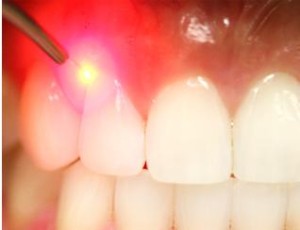 There are numerous advantages to using lasers in dental operations. A few of them include:
- Many operations that use soft-tissue lasers can be completed without the use of stitches.
- Some laser procedures do not require the use of anesthesia.
- Laser dentistry reduces bleeding. This is because high energy beams of light assist in the coagulation of exposed blood vessels, which inhibits the loss of blood.
- Infections caused by bacteria are lessened due to the beam sterilizing the area it hits.
- Damage to nearby tissue is minimalized.
- The healing process is faster and tissue can be regenerated.
Laser Dental Care Application
The application of lasers in the field of dentistry presents an opportunity for dentists to engage in a wide variety of procedures that may have previously been out of reach. Dentists who use lasers have become efficient at incorporating contemporary technology into a number of operations. These procedures can be grouped into three categories:
Hard Tissue (Tooth) Laser Procedures
- Cavity Detector: Lasers that are low on impact can be facilitated to find the early detection of cavities by giving a reading of the byproducts generated from tooth decay.
- Dental Fillings: Dental lasers used for hard tissue may get rid of the need for a local anesthesia injection as well as the turbine dental drill. Lasers used in the filling procedure are able to kill bacteria located in the cavity.
- Tooth Sensitivity: Lasers can be implemented to seal tubules (found on the tooth’s roof) that cause hot and cold sensitivity in teeth.
Soft Tissue (Gum) Laser Procedures
- Crown Lengthening: Gum tissue and bone can be reshaped by dental lasers to expose a healthier tooth establishment. Reshaping of this nature delivers a stronger foundation for the placing of restorations.
- Gummy Smile: Lasers can be used to reshape gum tissue for the purpose of exposing a healthy tooth structure and improving the look of a gummy smile.
- Muscle Attachment: The best treatment for children with a restricted frenulum or babies with limited tongue movement is a laser frenectomy. This procedure may also help with speech impediments.
- Soft Tissue Folds: Lasers can be used for a pain-free removal of soft-tissue folds caused by dentures that do not fit properly.
Other Laser Procedures
- Benign Tumors: Lasers can be implemented to remove benign tumors from the patient’s gums, palate, cheeks or lips in a way that is virtually painless.
- Cold Sores: Low-impact lasers minimize the pain in cold sores and assist in their healing time.
- Sleep Apnea: If sleep apnea has been caused by tissue overgrowth in the throat, a laser assisted procedure can be used to reshape the throat and alleviate breathing problems linked with the condition.
- Teeth Whitening: Low impact dental lasers can be applied to accelerate the bleaching process related to teeth whitening.
- Temporomandibular Joint Treatment: Lasers in dental care may be used to immediately minimize pain and inflammation of the temporomandibular joint found in the jaw.
Lasers signify a new and precise technology that will revolutionize hard and soft tissue procedures. Patients who choose laser dentists have found that they feel a greater level of comfort and a reduced level of anxiety. Considering that the laser is less intimidating than traditional tools, cleaner and quicker, it is clear that laser dental care has a bright future in the dentistry field.